
Shooting Pure Senses: what a day spa shoot actually involves
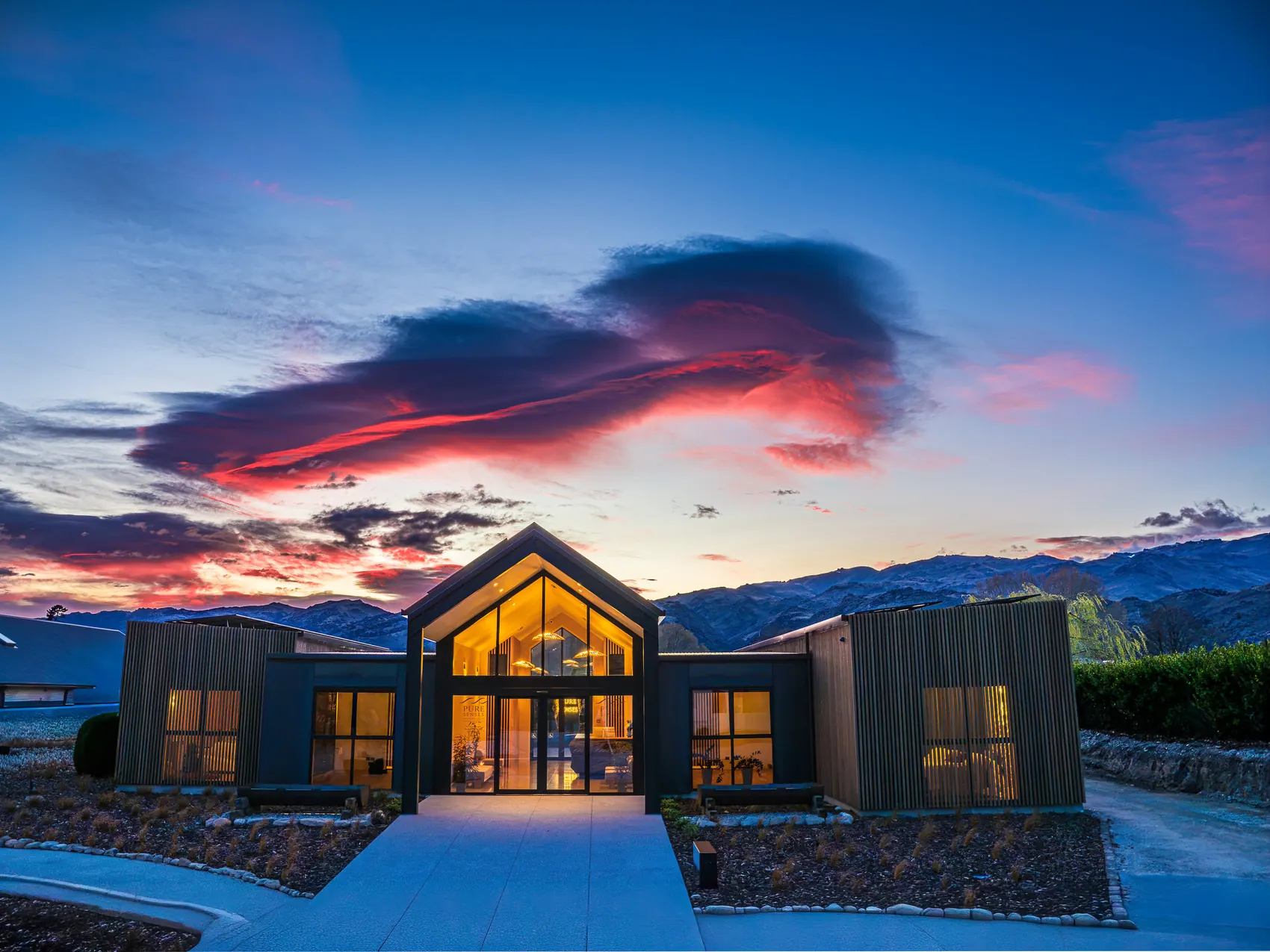
A day spa is one of the harder interiors to shoot honestly, because almost everything that makes it feel good in person works against a camera. The rooms are small. The light is dim and deliberately coloured. Half the surfaces are wet, mirrored, or both. And the thing you are actually selling is a feeling, which does not show up in a wide shot of an empty room.
We spent Thursday 3 September at Pure Senses, a new day spa at Mount Pisa near Cromwell, working alongside photographer Kirsten Summers across the building, with the images going to a spread in QT Magazine. This is what the day actually involved, including the parts that went sideways.
That clip is from the afternoon, once the treatment rooms were running. It is a fair picture of what a working spa shoot looks like from the inside: quiet, slow, and much more about waiting for a room to settle than about pressing the button.
The hero frame happened before anyone arrived
We were outside the building at 6am, before sunrise, for one exterior frame.
That timing is not about atmosphere. It is about balance. Once the sun is properly up, an exterior with warm interior lighting becomes an exposure you cannot win: either the sky is correct and the windows are black, or the windows are correct and the sky is blown out. In the twenty or so minutes before sunrise, the sky sits close enough to the interior lights that you can hold both in one exposure and still have the building read as lit and open.
It is a lot of driving for one frame, and that is usually the right trade. A magazine spread is one image, and the difference between the version that runs and the version that does not is almost always decided before anyone unlocks the door.
Our camera ruled out flash completely
The body we ran for the film and our own frames was a Sony FX30, which has no mechanical shutter. That is a genuine constraint rather than a preference. Without a mechanical curtain there is nothing for a strobe to sync to, so flash is not "avoid where possible". It is off the table entirely.
So our half of the day was available light and fast glass, mostly a Tamron 17-70mm f/2.8. In a spa that is less painful than it sounds, because the rooms are lit to be flattering already, and a bounced strobe would have destroyed exactly the mood the client is selling. But it does mean working near the bottom of your usable range all day, and being honest with yourself about which frames are actually sharp.
If you are commissioning spa or wellness photography, this is worth asking about directly. A shooter who lights the rooms will give you a cleaner, brighter, more commercial-looking set. A shooter working in available light will give you something closer to what the room actually feels like at 4pm. Both are valid. They are not the same product, and the difference is bigger than most briefs account for.
The lighting that sells the room is the lighting that breaks the camera
The Reset Studio at Pure Senses runs a traditional Yume Japanese head spa, and it is the best-looking room in the building: a large orange neon sign on the wall, and colour-cycling LEDs built into the basin, so the water glows blue, then green, then magenta through the treatment.
It is also a trap. Most architectural LED and neon dims by switching on and off very fast rather than by actually getting darker. A rolling shutter reads the sensor from top to bottom, so when the light flickers faster than the readout, some rows get caught during the off phase. You get horizontal banding through the frame, and on a body with no mechanical shutter you cannot escape it by changing shutter type.
The fix is Variable Shutter, which lets you tune the shutter in fine increments rather than jumping between standard speeds. You dial it in while watching live view until the bands slow, stop and disappear. The part people underestimate is that this is a per-room job, and sometimes a per-fixture one. The neon sign and the basin LEDs were not running at the same frequency, so a setting that cleaned up one brought the banding back in the other.
Budget time for it. In a room like that we allow fifteen minutes of doing nothing but staring at live view before a single usable frame exists.
Two saunas, two completely different problems
We shot both the Finnish sauna and the infrared sauna, and they behaved nothing alike.
The Finnish sauna is a heat and humidity problem. Glass fogs the moment it comes through the door, so the lens has to acclimatise inside the room before it is any use, and you get a narrow window before condensation returns. The timber is also far warmer in colour than it looks to your eye, and if you correct it to neutral the room stops looking like a sauna.
The infrared cabin is a colour problem. It is lit almost entirely in saturated red, and in that situation you are no longer exposing for overall brightness. You are exposing for the red channel, which clips long before the image looks bright on the back of the camera. Once red is clipped, skin in that room is unrecoverable, and no amount of grading brings it back. We shot it deliberately darker than looked right at the time, which is uncomfortable and correct.
The widest lens on the job was hired
The FX30 is an APS-C body, so its crop factor makes 17mm behave like about 25mm. In a treatment room or a wet room that is not wide enough. You end up backed into a corner with the frame still too tight, and the room photographs as smaller than it is, which is the opposite of what the client needs.
We hired a Sony E 10-18mm f/4 for the day, giving roughly 15 to 27mm equivalent, which covers the small rooms properly. One trap worth flagging, because it catches people: putting a full-frame ultra-wide on this body does not solve it. A 16-35mm on APS-C crops to about 24-52mm, no wider than the zoom already fitted. The lens has to be designed for the smaller sensor.
What to sort before a spa shoot
If you run a spa, clinic or wellness space and you are planning a shoot, most of the difference is made in the week before rather than on the day:
- Decide which rooms actually earn a shoot. Six rooms done properly beats twelve rushed. Rank them before anyone arrives.
- Book talent who are genuinely comfortable. Swimwear, heat and long waits between setups. This is not a job for someone doing you a favour.
- Have the rooms treatment-ready, not just tidy. Fresh towels, water poured, candles lit, robes hung. An empty clean room reads as a showroom.
- Know your own lighting controls. Someone on site needs to switch the coloured LEDs, dim the ceilings and close the blinds without hunting for a breaker.
- Agree who signs off. Especially when images are going to a publication with its own deadline and its own file spec.
That last one matters more than it sounds. A magazine will hand you a spec like "JPEGs, 3 to 5MB" and nothing else, and it is on you to work out the dimensions, the colour space and where the fold lands.
Credits
Shot on location at Pure Senses, Mount Pisa, with Ayala, Lilly and Catalina, and with Ayala also running The Reset Studio. Interior and treatment photography by Kirsten Summers. Exterior hero frame and film by FanCast Productions.
We work across Queenstown and Central Otago, usually as a combined stills and brand content day, so one shoot feeds a website, a print spread and a month of social video. If you have a space that needs shooting properly, get in touch and tell us the deadline.