
One morning, three reels: 8 lessons from filming a scaffold build for social media
By Dave Maguire, FanCast Productions
On Monday 19 October we spent a morning inside the voco Queenstown lobby with Queenstown Scaffolding. Their crew had six hours to put a scaffold up against the hotel's glass wall, so the windows could be tinted, while the hotel stayed open. We came away with a time-lapse and three vertical reels. The full job is written up in our case study; this post is about what we learned filming it, because most of it applies to any trade job you want on social media.
1. Find the deadline, because that is your story
A scaffold going up is not a story on its own. A scaffold going up in a hotel lobby that is empty at 9am and full of guests at 3pm is. That one line became the opening title of the first reel: "Empty lobby. Guests at 3pm."
Most trade jobs have something like it. A shop that reopens on Monday, a deck that has to be finished before the wedding, a roof that has to be closed in before the weather turns. Ask what the pressure is, and build the video around it.
2. Set up the time-lapse first, and protect it
The time-lapse went up first thing and ran from just after 9am to after 1pm. It is the cheapest shot of the day and often the one people watch twice, but it only works if nothing interrupts it.
Ours did not have an easy morning. The camera was moved twice, and for a stretch someone stood right in front of the lens. We could still cut a clean 30 seconds, but only just. Put the camera somewhere nobody needs to walk, tell the crew it is there, and check on it every hour.
3. Film the details that prove you know what you are doing
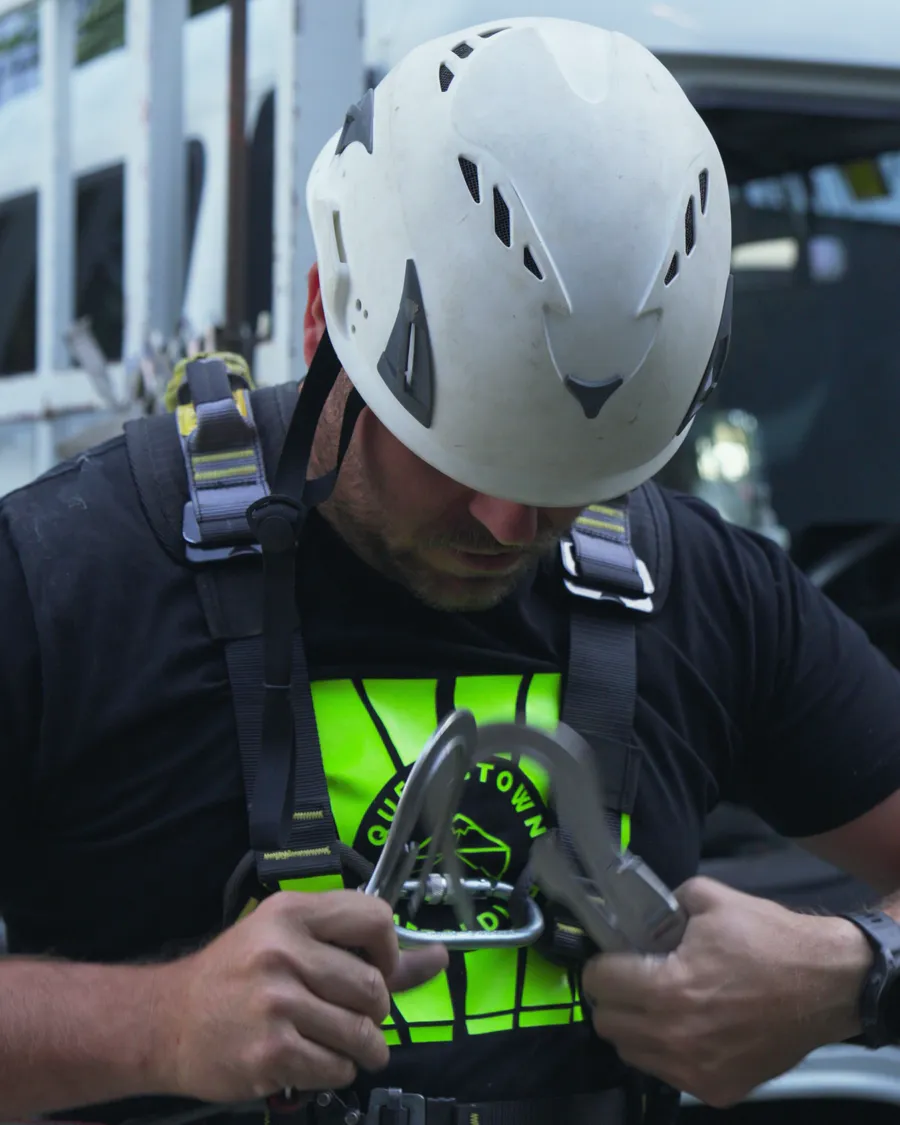
Wide shots show that a job got done. Close-ups show how well. On this shoot that meant harnesses being checked, clips going on, levels on the tubes and the scaffold tag on the frame. Put together, they became the second reel, "Done right".
For a scaffolding company that matters more than any drone shot. The people who hire them, from main contractors to hotel managers, want to see a crew that does things properly.
4. Get two minutes with the boss
We did not script anything. Between lifts we asked Eli a few plain questions: what the job was, how he planned it, and who was on his crew. His answers did the rest. He measured it up about six weeks earlier with lasers and levels, worked out how to span the hotel's glass canopy, and runs a crew of ticketed scaffolders who have been with him for years.
Real answers in the owner's own words land better than any voiceover we could have written. Keep the questions simple, let the answer run, and do it where it is quiet enough to hear.
5. Caption only what you are sure of
Every reel carries burned-in captions, because plenty of people scroll with the sound off. On a noisy site, though, speech is easy to mishear. In one of Eli's lines, the transcription kept hearing a word that made no sense for scaffolding, and we could not be sure what he had actually said, so we left that line out rather than guess. A wrong word on screen, in a trade where the terms matter, looks worse than a shorter reel.
6. One idea per reel
We could have made one long video. Instead the morning became three short ones, each with a single idea: the time-lapse, the craft and safety, and the crew's morning from the truck to the top lift. Three reels give a business three weeks of posts from one shoot, and each one is easy to understand in the first two seconds.
7. Remember whose building it is
Filming on someone else's site comes with rules. Inside a hotel that meant permission from the main contractor before any camera came out, and keeping guests out of the frame the whole time. Sort the permission before the day, and be ready to wait for a shot rather than film someone who did not agree to be in it.
8. Expect the windows to fight you
A glass wall with a bright morning behind it is hard to film. Expose for the crew and the windows blow out to white; expose for the windows and the crew turn into silhouettes. We shot in a log profile to keep detail in both, then brought the view back in the grade so the mountains show through the glass. If you are filming on a phone, try to shoot the window side when the sun is not on it.
Want your next job filmed?
If you run a trade business in Queenstown or Central Otago and want your work on social media, we can film a morning on site and turn it into a set of reels. See our social media video service, or watch all three Queenstown Scaffolding reels on our portfolio.